Sizing
What Size Dumpster Do I Need in Wentzville?
The definitive sizing guide for St. Charles County projects: real dimensions, honest pickup-load equivalents, why full basements change the math, and when weight beats volume.
The question comes in twenty times a week and it is almost always asked backwards. People start with the room — "it's a kitchen" — when the thing that actually decides the box is what the debris weighs and how much of it there is once the house gives up everything it has been holding. In St. Charles County that second part has a specific answer, and it is the basement.
Cole and Wes have been dropping roll-offs in Wentzville, O'Fallon, Lake Saint Louis and out toward New Melle since 2015. What follows is how we actually size a job here, and why the generic online guides get Missouri houses wrong.
The five sizes, straight
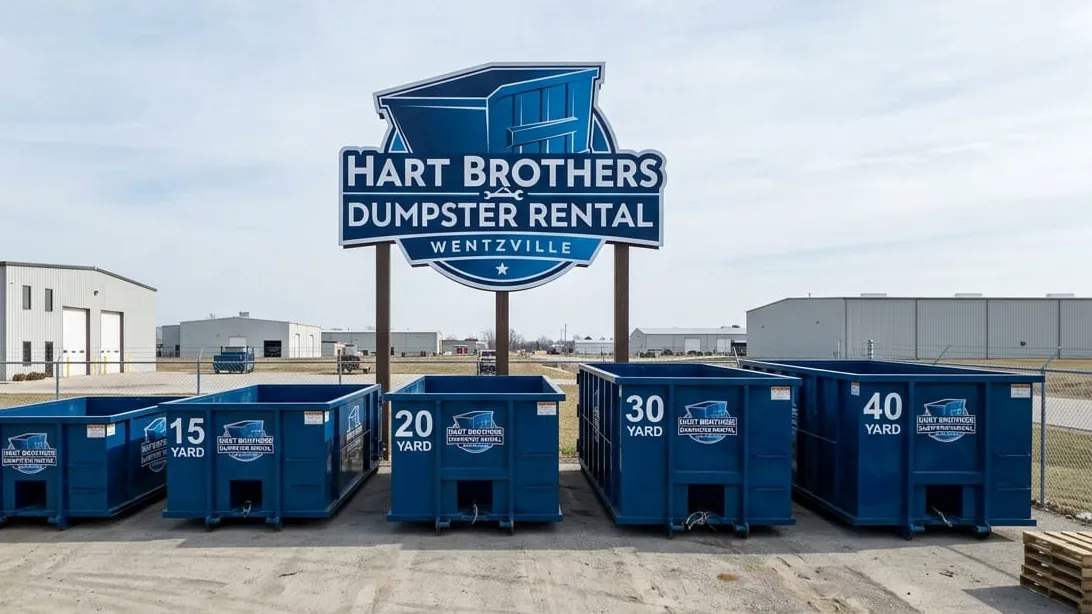
All five of our boxes are eight feet wide. The 10 and 15 are shorter; the 20, 30 and 40 share the same 22-foot footprint and just get taller. That matters more than people expect: if a 20 fits your driveway, so does a 30, because you are not adding length, you are adding walls.
| Size | Dimensions (L×W×H) | Typical weight allowance | Honest pickup-load equivalent | What it is actually for in St. Charles County |
|---|---|---|---|---|
| 10 yard | 12 × 8 × 3.5 ft | About 2 tons | 4–5 full-size truck beds | Concrete apron, patio or sidewalk tear-out; a single bathroom; a small garage purge. |
| 15 yard | 16 × 8 × 4 ft | About 2–3 tons | 6–7 truck beds | Kitchen gut without cabinets, a one-layer roof, or a driveway too tight for a 22-footer. |
| 20 yard | 22 × 8 × 4.5 ft | About 3 tons | 8–10 truck beds | The county workhorse. Most roof tear-offs and single-room remodels. Low enough to pitch over the rail. |
| 30 yard | 22 × 8 × 6 ft | About 4 tons | 12–14 truck beds | Full-house cleanouts with the basement. Deck tear-offs, whole-house siding, basement finishing, estate jobs. |
| 40 yard | 22 × 8 × 8 ft | About 4–5 tons | 16–18 truck beds | Bulky and light only: framing lumber, siding, cabinetry, fencing, commercial fit-outs, pole-barn cleanouts on acreage. |
On the pickup numbers: a full-size bed holds roughly two cubic yards level and maybe two and a half heaped, which is why the "a 10 yard equals three pickup loads" line you see everywhere is optimistic. Assume four to five real, safely loaded trips and you will not be disappointed. Weight allowances vary by material and facility, so confirm tonnage when you book. Full specs for each box sit on our dumpster size comparison page.
The basement is the sizing fact that matters most here
Nearly every house in St. Charles County has a full basement. Finished or unfinished, it is a whole extra floor, and it is the floor where thirty years of decisions get stored: the workshop bench, the laundry area, exercise equipment nobody has touched since 2011, holiday bins, and the boxes from three previous moves that were never opened.
Almost every sizing guide on the internet was written for slab-on-grade housing — Florida, Texas, Arizona. Those guides systematically undersize Missouri jobs, and they do it by a full container size. A 1,800-square-foot ranch in a southern market is 1,800 square feet of contents. The same ranch off Highway Z is 1,800 upstairs and another 1,800 down.
Our rule: for any whole-house cleanout, size the above-grade floors, then go up one. A house that reads like a 20 is a 30 as soon as somebody opens the basement door. If the basement is finished and coming out — carpet, pad, drop ceiling, panelling, framing — that is its own container, and we cover that job in detail in our guide to basement finishing and cleanout debris.
Weight beats volume on dense material
Here is where people get hurt. Concrete, block, brick, tile, thinset and mortar run roughly 2,400–2,800 pounds per cubic yard. Do that arithmetic once and the whole picture changes: two tons is about a yard and a half of concrete. Not fifteen. One and a half.
So a driveway apron that freeze-thaw finally destroyed, or a patio tear-out behind a house in Cottleville, is tons long before the box looks full. We put dense material in a 10 yard dumpster on purpose — low walls, easy to load by hand or wheelbarrow, and the truck can legally pick it up. A 30 loaded with concrete does not leave the driveway; it just sits there being a problem.
The same math catches egress window cut-ins, common now that people finish basements to code. Cutting through an eight-inch poured wall and digging the well out produces block spoil plus excavated clay, and eastern Missouri clay is heavy, wet-holding and as dense as the concrete. Treat that spoil as a separate dense load. We handle those on our concrete and heavy debris service, and if there is any question about which material can be mixed, our rundown of what can and cannot go in a dumpster in St. Charles County covers it.
Wet basement material is the other weight trap
Expansive clay moves with moisture, cracks foundations and pushes water through basement walls. Add a sump pump that quits in a spring storm and a finished basement is ruined in a few hours.
Soaked carpet and pad, saturated drywall, particleboard furniture that has wicked water up the legs — all of it is dramatically heavier than the same material dry. Carpet and pad can double. We have watched a 30 yard dumpster go overweight looking half full on a water job, and it surprises the homeowner every time.
Roofing is sized by squares and layers, not roof area
Roofers already speak the right language. A square is 100 square feet, and the container is driven by squares times layers times shingle type. Architectural shingle is heavier than the old three-tab, and a lot of the county's older stock is carrying two or three layers because somebody shingled over rather than tearing off.
Rough working numbers: a 20 yard dumpster handles most single-layer jobs up to the mid-twenties in squares. Two layers halves that. Three layers on a 1970s house means you are on a 30 or you are swapping. Hail seasons out here fill the calendar fast, and we go deeper on the arithmetic in our roofing tear-off dumpster size guide. One caution: pre-1980 roofing felt can contain asbestos, and we cannot accept asbestos-containing material in any container. That is a stop-and-test moment. Missouri DNR runs the state asbestos programme and rules change, so verify current inspection and notification requirements before a tear-off on old stock.
Plaster and lath in the old stock
Historic downtown Wentzville around Pearce Boulevard, and Historic Main Street over in St. Charles, hold 19th-century brick and frame houses built with plaster over wood lath. Plaster and lath runs roughly two to three times the weight of drywall for the same volume, and it comes off the wall in dense, wet-feeling chunks with nails in them.
Size a plaster gut like drywall and you will be over. Size it like light demolition and you will be fine. The old-growth framing in those houses is denser than modern lumber too.
The bulky-light jobs that genuinely want the big box
The 40 is not a bigger 30 for heavy work. It is a taller box for material that eats volume without generating tonnage:
- Deck framing and boards. A 1990s subdivision deck is a lot of cubic yards of dry treated lumber and not many pounds.
- Vinyl siding, soffit and trim. Almost weightless, enormously bulky, and it will not compact.
- Cabinetry. Uppers and lowers out of a full kitchen fill a box faster than anything else.
- Fencing. Wood privacy panels after straight-line wind, whole runs at a time.
- Commercial fit-outs. Ceiling grid, tile, office partitions and shelving on a tenant turnover. That is commercial dumpster rental territory, usually a 40 with a swap.
The catch is height. A 40 has eight-foot walls, so everything goes through the rear swing doors or gets lifted overhead. With a one or two-man crew, two 20s often beat one 40 for loading speed.
The first-refresh wave
Whole streets of 1990s and early-2000s houses went up together here, which means they are wearing out together. We are on the same block three times a year for different owners doing the same four jobs.
| First-refresh job | What it usually takes |
|---|---|
| Deck tear-off and rebuild | 30 — bulky, light, and the old railing packs badly |
| Second or third roof | 20 for one layer, 30 for multi-layer or big footprints |
| Original kitchen out | 15 without cabinets, 20 with, 30 if flooring and a wall go too |
| Basement finish-out | 20 for a clean build; 30 if you are clearing stored contents first |
| Whole-house cleanout, basement included | 30, occasionally 40 |
Deck jobs in particular tend to snowball into railing, stairs, skirting and whatever was stored underneath — we wrote up that pattern in our piece on deck removal and first-refresh remodels.
Fitting it on the property
The right size is also the size that physically gets there. What we need:
- Roughly 60 feet of straight approach so the truck can back in and roll the box off level.
- About 10.5 feet of width — the box is 8 feet, the truck needs shoulder room.
- 20-plus feet of overhead clearance for the hoist arm. Low limbs, service drops and basketball hoops are the usual offenders.
- Protection boards, which we put down as standard.
Two local conditions matter. Freeze-thaw-cracked aprons are everywhere after an eastern Missouri winter, and a cracked apron is where a loaded box does its damage. And expansive clay that has already heaved a slab leaves an uneven surface where a container can rock. Point both out — there is more in our notes on protecting a driveway during delivery.
West and south of town it changes. Out toward New Melle, Defiance and Foristell you have long gravel drives that rut badly when wet, and in March they are always wet. Flag your septic tank, lateral field and well head before we arrive; a loaded 30 parked over a lateral field is an expensive afternoon. Underground utility locates are free through Missouri 811, and if the container is going anywhere near a public street or right-of-way, permit rules vary by jurisdiction — check current requirements with the City of Wentzville or St. Charles County, because they do change.
Timing, because the calendar is real
Two things book us out. Spring storm season — hail, wind, tornado damage — puts entire neighbourhoods into re-roof and fence replacement in the same week. And GM Wentzville shutdown weeks put thousands of people at home with time to remodel, all at once. A shift-work town remodels on weekends, and everybody wants a container on Friday. Call early on either.
How to describe your job on the phone
Give us these five things and we will size it correctly the first time:
- The material. Not the room. "Concrete and block," "shingles," "carpet, drywall and stored boxes."
- Whether the basement is in scope. This changes the answer more than anything else you can tell us.
- Wet or dry. If there was water, say so.
- Roof jobs: squares and layers. Your roofer knows both.
- Where it goes. Driveway, gravel, street, acreage — and any overhead limbs, septic or well.
If you are between two sizes, take the bigger one on light material and the smaller one on dense material. That single rule prevents most of the problems we see. And if you need more room, a next-day swap beats cramming it.
Tell us what you are actually throwing away and we will tell you which box — no guessing, flat-rate pricing, protection boards down, same-day and next-day delivery across St. Charles County. Call Hart Brothers Dumpster Rental Wentzville at (636) 538-6201, or send us the details on your project and we will size it for you.
Questions this guide did not answer? Call (636) 538-6201. We would rather spend two minutes on the phone than have you order the wrong container.