
Basements
Basement Finishing and Cleanout Debris in Wentzville
Nearly every house in St. Charles County has a full basement, and it drives more container work than anything else. How to size for a finish job, an egress cut-in and a wet gut.
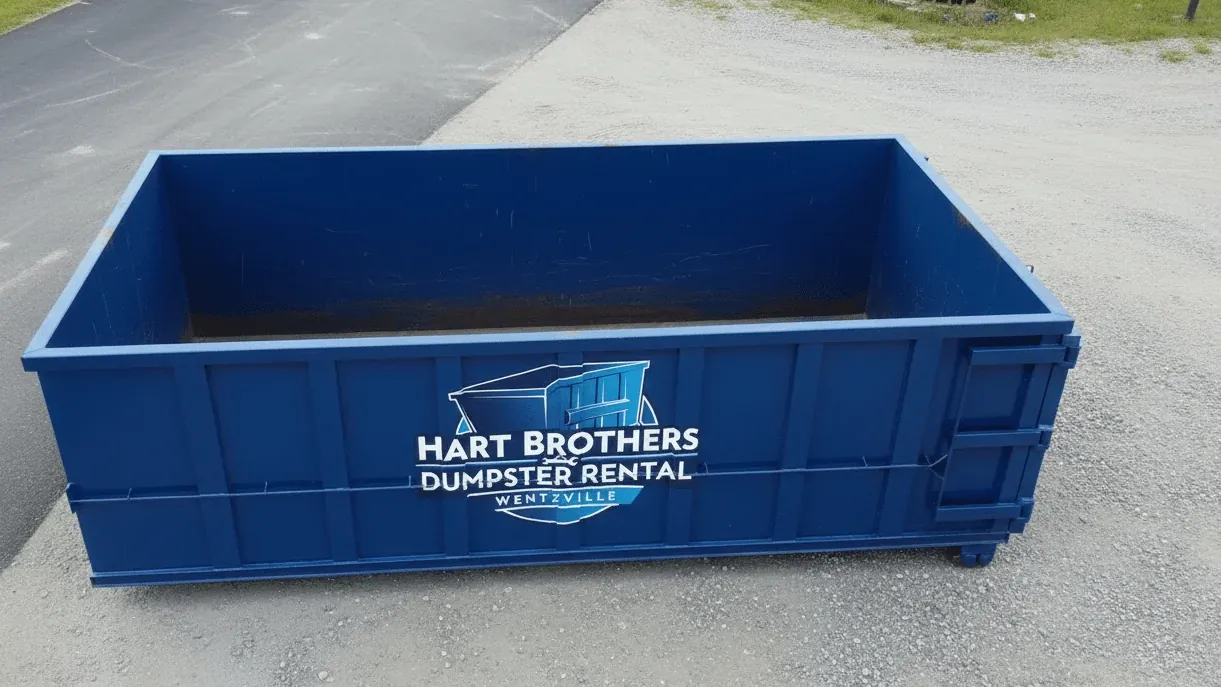
Nearly every house in St. Charles County has a full basement — finished, half-finished, or bare block with a floor drain and forty years of boxes — and that one fact drives more container work in Wentzville than roofs, decks and kitchens put together. Sizing guides written for the south miss it entirely, because down there a house is a slab and an attic. Here it is a whole extra floor of contents, and the most common reason a homeowner orders the wrong size.
Cole and Wes have been pulling basements out of houses in Wentzville, O'Fallon and out west toward New Melle since 2015. The work splits into two families that load completely differently: finishing an unfinished basement, or clearing one out and gutting it after water.
Two basement jobs, two different loads
A finish job produces bulky, light debris — framing offcuts, drywall, carpet, insulation, packaging. It fills volume fast and barely moves the scale. A water gut or egress cut-in produces dense debris — soaked carpet, saturated drywall, concrete and block spoil, excavated clay — and weighs out long before the box is full.
The mistake we see most is treating those as one order: a 30 for the framing and drywall, egress spoil thrown in on top, overweight on a box that still looks two-thirds empty. Two loads, sized separately, is cheaper and legal — our guide to choosing the right dumpster size in Wentzville has more examples.
Finishing an unfinished basement
The 1990s and early-2000s subdivisions along Highway Z, Highway N and out past David Hoekel Parkway are hitting their first refresh all at once. Those houses were built with the lower level roughed for a bath and left bare, and twenty-five years on the owners are finally closing it in.
What comes out before the first stud goes up
Almost nobody budgets for this. An unfinished basement is the household's junk drawer scaled to a thousand square feet: the previous owner's storage that came with the house, steel and particleboard shelving, an old workbench, leftover materials from the original build — siding panels, half a bundle of shingles, deck boards, hardened mortar — plus boxes from three moves ago and whatever lived in the utility area. That pre-clear is half the debris on these jobs and deserves its own phase, so the trades are not working around piles. Our home cleanout checklist covers this pass.
What the build itself generates
The finish work then produces a predictable stream: framing offcuts and busted studs, drywall scrap and empty mud buckets, carpet and pad trim, ceiling tile and grid, batt or rigid insulation, and a startling volume of packaging from doors, trim, lighting and flooring. None of it is heavy, all of it is bulky, and most of it wants breaking down before it goes in or you pay for air. On a typical Wentzville subdivision house a 20 yard roll-off handles the build debris comfortably, with a 30 yard for a big walkout or when the pre-clear and the build run together.
Egress windows: the dense load nobody plans for
Any bedroom you create down there needs an egress window, and cutting one into a poured or block foundation wall is a different job from the rest of the project. You get sawn concrete or block spoil, excavated clay from the window well, and often broken-out slab where drain tile gets reworked. A pickup bed of wet clay and rubble outweighs a room's worth of framing.
Put it in a small container by itself. A 10 yard is the right box for concrete and dirt; a 15 yard covers a larger cut-in with slab work. Clean concrete and block kept away from wood is also recyclable rather than landfill — see our notes on concrete and heavy debris disposal.
Radon, moisture and why you do not close the walls yet
Radon is elevated across eastern Missouri, and a finish is the moment to deal with it — the suction pit and riser go in far easier before the walls close, so mitigation often gets done alongside the framing. The Missouri Department of Health and Senior Services and the EPA both publish testing guidance; standards change, so confirm current recommendations before you plan around them.
Moisture is the other thing to settle first. Frame off the poured or block wall rather than tight to it, use a moisture barrier and rigid foam instead of batt against bare concrete, and run the space through a wet season before you rock the walls. If the floor sweats in August or a damp line shows at the base of the wall after a hard rain, fix that first. Closing a wall over a damp foundation buys you a mould job in three years.
Clearing out or gutting after water
Why basements here get wet
The expansive clay soil across eastern Missouri swells wet and shrinks dry. It works against foundation walls year after year, opens cracks, and pushes water through block joints and cold joints. Add the usual failures — a sump pump that quits in a spring storm, a backed-up floor drain, a burst laundry supply line, a water heater letting go — and a finished basement is soaked in hours. The same clay cracks driveways, which is one reason we bring protection boards on every delivery.
Wet material is enormously heavy
Carpet and pad hold an astonishing amount of water. Saturated drywall — usually cut at 12 or 24 inches, above the visible wicking — is several times the weight of dry board. Particleboard and MDF furniture swells into waterlogged sawdust. Cardboard, stored paper and boxes of photographs come out as sodden bricks.
A 30 of soaked material can pass legal road weight while looking half full, and at that point it cannot leave your driveway. A smaller container hauled twice beats one big box: a 15 or 20 yard on a next-day swap moves the same material without the weight problem. Tell us it is a wet basement when you call and we size it that way.
What goes and what can be dried
Some of it is not a judgement call. Carpet and pad go. Wet drywall and the insulation behind it goes. Particleboard and MDF furniture, cabinets and shelving go, along with cardboard, paper and any upholstered furniture that sat in standing water. What can usually be dried and saved: solid wood, metal, concrete and block, ceramic tile and glass. Pull those out before demo and the load shrinks noticeably.
Mould, and Category 3 water
Mould gets going in a day or two in a warm, closed Missouri basement, and once it is into the paper facing on drywall the scope grows in every direction. That is the argument for a container on site fast — same-day and next-day delivery keeps a two-room gut from becoming a whole-floor gut. Our demolition debris service is set up for that pace.
If the water came up through a floor drain or a sewer backup, it is Category 3 — contaminated. Far more gets thrown, porous material is not salvageable no matter how good it looks, and you want a remediation contractor rather than a weekend. Standards here get revised, so confirm current expectations with your contractor and your carrier.
Photograph everything before it moves
Before a single piece of carpet comes up, document it: wide shots of each room, close shots of the water line, serial numbers off the furnace, water heater and appliances, and the contents being thrown. Once material is in the container that proof is gone. Insurance rules and deadlines vary by policy and change over time — call your carrier before you start throwing, not after.
Basement scenario, debris and container approach
| Basement scenario | Dominant debris | Dense or bulky | Container approach |
|---|---|---|---|
| Pre-clear before finishing | Storage boxes, shelving, workbench, leftover materials | Bulky | 15 or 20 yard, staged before trades start |
| Full basement finish | Framing offcuts, drywall, carpet and pad, ceiling tile, insulation, packaging | Bulky | 20 yard with a next-day swap; 30 on a large walkout |
| Egress window cut-in | Sawn concrete and block spoil, excavated clay, slab pieces | Dense | 10 yard on its own, kept clean for recycling |
| Dry basement cleanout | Decades of storage, furniture, exercise gear | Bulky | 20 or 30 yard, one drop, loaded high |
| Wet gut, clean water | Soaked carpet and pad, drywall cut at 12–24 in., particleboard furniture, cardboard | Dense | 15 or 20 yard hauled twice — never a 30 |
| Sewer backup (Category 3) | All porous material plus contents that touched water | Dense | Remediation contractor leads; smaller staged containers |
| Pre-1980 basement demo | Suspect pipe and duct wrap, floor tile and mastic, plaster | Varies | Test before demo — no container takes ACM |
Pre-1980 basements: stop and test
Older houses around Pearce Boulevard and on historic Main Street in St. Charles carry a different risk profile below grade than a 1998 subdivision. Pre-1980 basements routinely have asbestos in the insulating wrap on old ductwork, boilers and heating pipes, in 9-inch floor tile and the black mastic under it, and in plaster skim coats. The wrap around a gravity furnace is the one people rip into without thinking.
The rule is simple: if the house predates 1980 and you are about to disturb pipe wrap, duct wrap, old floor tile or plaster, stop and have it tested by a licensed inspector. Missouri DNR runs the state asbestos programme, and demolition generally triggers a NESHAP inspection and notification. We cannot accept asbestos-containing material in any container, at any size. It goes to a licensed abatement contractor and a permitted facility. Requirements change, so confirm current rules with DNR before you schedule demo.
Access: everything comes up the stairs
A basement is the one part of the house where every pound of debris gets carried uphill by a person. A walkout or exterior cellar doors changes the math enormously — you can wheelbarrow or chute straight out to a container parked at the low side. An interior stairwell means buckets and armloads, and a 30 yard box that takes three days to fill instead of one.
Tell us which door you are actually using when you book. We set the container as close to it as the drive and truck allow, square to the path, doors swinging the way you need. Protection boards are standard — freeze-thaw already works on St. Charles County driveways every winter. Long gravel drive toward Defiance or Flint Hill? Mention it and we plan the approach differently.
What cannot go in the container
Basements are where the household chemicals live. Keep these out and take them to a St. Charles County household hazardous waste drop-off:
- Paint, stain, solvents and adhesives
- Gasoline, kerosene, motor oil, antifreeze and propane cylinders
- Pool chemicals, lawn and garden chemicals, pesticides and fertiliser
- Batteries of every kind, car and lithium included
- Tires
- Electronics, televisions and computer equipment
- Refrigerators, freezers, air conditioners and dehumidifiers holding refrigerant
Drop-off schedules and accepted items change, so check current county details first. Our guide to what can and cannot go in a dumpster in St. Charles County has the full list.
Pull the scrap metal first
Before anything else goes in the box, walk the basement for metal: an old furnace or replaced water heater, cast iron radiators and drain stack, steel shelving, a treadmill nobody has used since 2009, copper offcuts, aluminium storm windows. Yards along the I-70 corridor take all of it, and pulling it first takes real weight out of your load. On a full residential cleanout it is often the difference between one container and two.
Get the container placed right
Finishing a basement out on Highway P, clearing forty years of storage from a house in O'Fallon, or gutting a soaked lower level after a sump pump failed — Hart Brothers will size it honestly and put it where you can actually work. Flat-rate pricing, licensed and insured, same-day and next-day delivery, next-day swap-outs, protection boards on every drop. Call Cole or Wes at (636) 538-6201 or send the details through our contact page, and tell us which door you are carrying it out of.
Questions this guide did not answer? Call (636) 538-6201. We would rather spend two minutes on the phone than have you order the wrong container.