
Storm Cleanup
Storm and Hail Damage Cleanup in Wentzville
What to do with the debris after severe weather hits St. Charles County: document before you demolish, keep tree debris as a separate clean load, and call before the region books out.
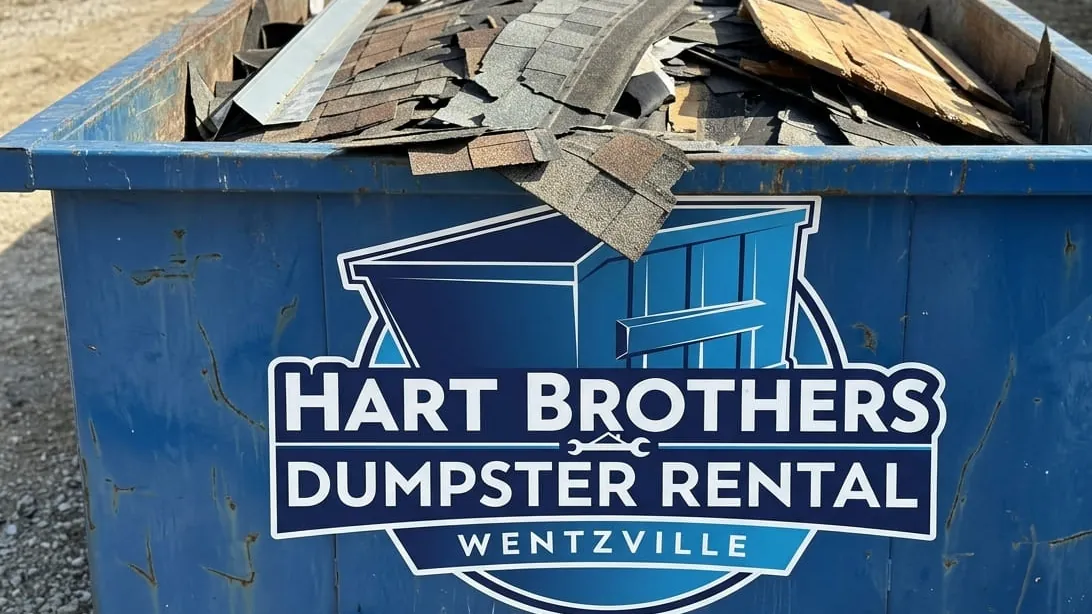
The morning after a cell comes through St. Charles County, the phone starts before six. Shingles in the flower beds, a fence flat across the neighbour's yard, half a silver maple on the driveway. Everybody wants the same thing at once, and the people who get cleaned up first make three calls in the right order: insurance, roofer, container.
Cole and Wes have run roll-offs through Wentzville storm seasons since 2015. Here is what goes in a box, what legally cannot, and how to keep a hail claim from being complicated by a pile that left too early.
The eastern Missouri severe-weather calendar
Spring and early summer are the big ones: tornadoes, large hail and straight-line wind. St. Charles County sits at the eastern edge of the country's most active severe-storm corridor — not plains frequency, but the same intensity, delivered into dense subdivisions with mature trees over them. One supercell along the I-70 corridor can put four or five neighbourhoods into re-roof at once.
Winter damage is slower. Ice storms load limbs until hardwood snaps, then hard freeze-thaw works on driveways, aprons and steps all season. That debris shows up in March as concrete, not shingles.
Then there is water. The 1993 flood on the Missouri and Mississippi is still the regional benchmark, and the Missouri River bottoms flooded again in 2019 — the low ground along Highway 94 plays by its own rules. The National Weather Service is worth bookmarking before the season, not during it.
Hail is the most common claim, by a wide margin
Wind gets the headlines; hail writes the checks. A hail core works over every soft surface on the elevation it hit:
- Asphalt shingles, with granule loss and mat fractures a good adjuster finds and a homeowner in the yard will not
- Gutters and downspouts, dented along the top edge
- Vinyl and aluminium siding, cracked or holed on the impact side
- Soffit and fascia, especially aluminium wrap
- Window and door screens punched through, skylights and plastic glazing
- AC condenser fins, flattened on the storm-facing side, quietly costing you cooling all summer
The operational fact: a cell books the entire regional roofing trade in about seventy-two hours. Crews that were three weeks out become three months out, and each needs a container the day they start.
Document before you demolish
This is the advice we repeat most. The urge after a storm is to clean up. Do the documenting first.
- Photograph everything from multiple angles — wide shots establishing the house and elevation, then close-ups with something for scale
- Photograph the debris where it landed, before it moves
- Keep a physical sample: a damaged shingle, a cracked siding panel, a dented gutter section
- Get the claim opened, ideally the adjuster scheduled, before debris leaves
- Keep receipts for tarps, board-up and emergency mitigation
Once the claim is open and the damage recorded, the pile can go. Before that, a container leaving early takes the evidence with it. Plainly: Missouri insurance rules and claim deadlines change and every policy differs, so confirm your timeline with your carrier and the state department of insurance rather than taking a neighbour's word, or ours.
Roof tear-off is weight-driven, not area-driven
The most expensive mistake on a storm job is ordering a roofing container by roof size. Roofs are sized by squares and layers, and shingle is heavy. A second or third layer doubles or triples the weight without changing the footprint at all.
The older stock around Pearce Boulevard and Main Street routinely hides two or three layers, and nobody knows until the first square comes off. We would rather set a smaller box and swap it than send one a driver legally cannot pick up: a 15 hauled twice is a working day, an overweight 30 in the driveway is a stopped job. Our roofing tear-off dumpster size guide works through squares and layers, and the roofing dumpster rental service page covers how we stage boxes for crews working several houses on one street.
Wind and tornado debris
Wind damage is mixed, awkward and full of things that do not stack:
- Fence panels, rails and posts still carrying concrete footings — the footings are the hidden weight, and a hundred feet of privacy fence brings a lot of concrete
- Shed and outbuilding remains, which out toward New Melle, Defiance and Flint Hill means pole barns, not a plastic garden shed
- Carports, metal awnings, and siding, soffit, fascia and gutter torn off in sheets
- Downed trees and limbs
Fence and outbuilding debris is mixed construction waste and rides fine in a standard container. Cut it to length first — a whole panel wastes three panels' worth of space — and lay post footings flat on the floor. The demolition debris service covers larger outbuildings and carports.
Tree debris is its own load, and the law is not flexible
Missouri bans yard waste from sanitary landfills. Grass, leaves, brush and branches cannot be buried under state law, so storm tree debris rides as a separate clean load to a composting or organics facility — never mixed into a construction container. Put a few limbs on a roofing load and the whole box can be rejected at the gate. The Missouri Department of Natural Resources administers the rule; confirm current requirements first, because accepted materials change.
Local tree debris is oak, hickory, maple, sycamore, silver maple and Bradford pear, and homeowners underestimate it every time. Green hardwood limb wood is dense and full of water — a pile of oak that looks like a 20 weighs like something else. The yard waste removal service explains the clean-load side.
Bradford pear deserves its own line: planted by the thousand across these subdivisions in the 1990s, structurally terrible branch union, splits apart in wind with total reliability. Every serious storm here produces a run of them cracked down the middle.
The basement angle nobody plans for
Here is the sequence that catches people. The storm takes the power out. The outage takes the sump pump with it. Six hours later a wind event has quietly become a water event.
Nearly every house in St. Charles County has a full basement, and expansive clay soil pushes water at foundation walls whenever the ground is saturated. Wet carpet, pad and drywall are enormously heavy — a volume that would have been light dry weighs out a container long before it looks full. Size it as its own job. Our guide to basement finishing and cleanout debris in Wentzville covers wet-gut weights.
Where each kind of storm debris goes
| Storm debris | Container or route | Sizing note |
|---|---|---|
| Shingle tear-off | Dedicated roofing load, no mixing | Sized by squares and layers, not roof area; assume an extra layer |
| Gutter, soffit, fascia, siding | Mixed construction load | Light and bulky; flatten and nest panels or it eats volume |
| Fence panels and posts | Mixed construction load | Concrete footings are the weight; lay them flat on the floor |
| Shed, pole barn, carport | Mixed construction or demolition load | Cut to length; metal roofing is awkward, not heavy |
| Trees, limbs, brush | Separate clean load to compost or organics — banned from landfill | Green hardwood is far heavier than it looks; size down and swap |
| Wet carpet, pad and drywall | Separate load, sized by weight | Water can double the weight of a volume; smaller box hauled twice |
| Freeze-thaw concrete and steps | Clean concrete load | Heavy debris box only; keep it clear of wood and shingle |
| Propane, fuel, chemicals, tires, batteries, electronics | Household hazardous waste or take-back | Never in any container, no exceptions |
| Suspected asbestos material | Licensed abatement contractor | Stop and test; we cannot accept it in any container |
Container supply is the real bottleneck
When a big cell goes through, the whole region books out in days. Roofing crews reserve boxes in blocks, tree services take the clean-load capacity, and the homeowner who waits for the adjuster is calling into a queue that formed while they were on hold with their carrier.
Open the claim, take the photographs, call the same afternoon — you do not need a claim number to hold a delivery date. We run same-day and next-day delivery and next-day swap-outs, and after a storm those swap slots keep a job moving. Our service area covers Wentzville, St. Charles County and the western St. Louis metro, rural drives toward Foristell and Defiance included. Protection boards come standard, which matters on driveways already stressed by freeze-thaw — see our note on driveway protection during delivery.
Safety, honestly
Storm cleanup hurts more people than the storm does, most years.
- Downed lines. Treat every wire on the ground as live, cable and phone drops included. Do not move limbs touching wire.
- Generators and carbon monoxide. Outdoors only, away from windows and doors, never in an attached garage even with the door open. This is the one that kills people after outages.
- Nails. Everywhere once a roof comes off — grass, drive, mulch beds. Boots with a shank, not sneakers.
- Chainsaw work on tensioned limbs. A limb under load stores enormous energy and does not release the way you expect. Leaning, split or hung-up trees are a tree service call.
- Damaged roofs. Do not get on one. Decking hit by hail or lifted by wind gives no warning.
When the box leaves, run a magnet sweep over the drive, the parking pad, the lawn either side and the strip where the truck staged — two slow passes at right angles. Roofing nails in a tire are the most common post-storm complaint we hear, and entirely preventable.
What cannot go in the container
Storm cleanup surfaces the contents of garages and sheds, where the prohibited material lives. None of this rides in our boxes: propane cylinders, gasoline and oil, paint, solvents, pool chemicals, pesticides, tires, batteries, appliances containing refrigerant, and electronics. Leftover paint and chemicals go to a St. Charles County household hazardous waste drop-off — check current dates and accepted items first, because those programmes change.
The stop-and-test item is asbestos. Pre-1980 houses here routinely carry it in siding, roofing felt, floor tile and mastic. If old felt under a tear-off looks unusual, stop and have it tested. Missouri DNR runs the state asbestos programme and demolition generally triggers inspection and notification requirements, which do change — confirm before you start. Fuller breakdown in our guide to what can and cannot go in a dumpster in St. Charles County.
The municipal side, and what it does not cover
After a major event, the City of Wentzville and St. Charles County sometimes stand up special storm-debris collection. Worth knowing about, and worth knowing its limits.
What it is good at: curbside vegetative debris, in volume, at no direct cost. What it is not: fast or flexible. Passes run for weeks, sorting is strict — brush separate, nothing bagged, cut to specified lengths — and a pile with one sheet of drywall in it gets left for the whole street to look at.
It also does not touch what you carry out of the house yourself. Wet carpet, ruined furniture, soaked drywall, roof tear-off — none of that is storm-debris collection material. If the damage went inside, you need a container. Rules vary by event and jurisdiction, so confirm with the city or county before stacking anything at the curb.
Get a box on the ground
Storm work is the one job where calling early changes the outcome. Photograph the damage, open the claim, then hold a delivery date before the region books out. We run 10, 15, 20, 30 and 40 yard roll-offs, we will tell you when a job needs two smaller loads instead of one big one, and we keep clean tree loads separate the way state law requires. Unsure how a job splits? Our dumpster size guide for Wentzville is a good start, or call and describe what is in the yard. Hart Brothers Dumpster Rental, 55 May Rd in Wentzville, licensed and insured, flat rate, protection boards standard. Call (636) 538-6201.
Questions this guide did not answer? Call (636) 538-6201. We would rather spend two minutes on the phone than have you order the wrong container.