
Delivery
Driveway Protection During Dumpster Delivery in St. Charles County
A roll-off truck is not what marks concrete — the container's rails and wheels are. Here is how we protect St. Charles County driveways, and what you should do before delivery day.
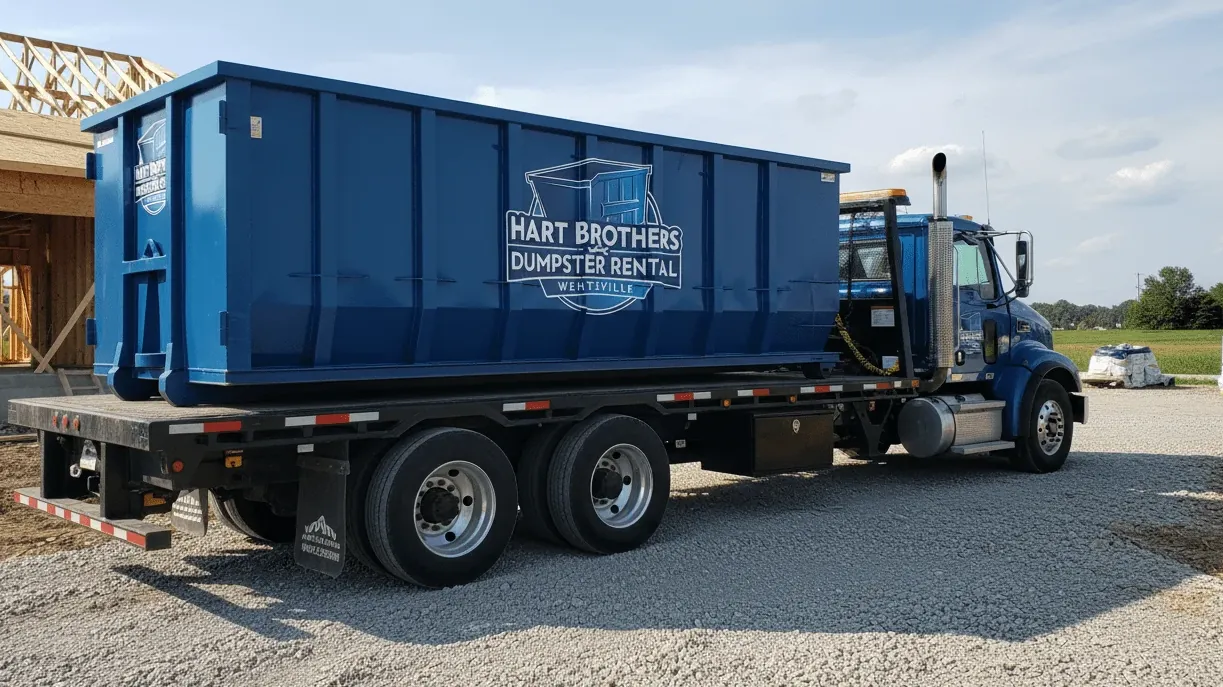
The call we get most often in February starts the same way: somebody wants a container for a basement cleanout, and before they ask about sizes they ask whether the truck will wreck the driveway. Fair question. The driveway is the most expensive flat surface on most properties, and in eastern Missouri a lot of those slabs are already losing a fight with the dirt underneath them.
Here is the honest version, from a crew that has been backing down St. Charles County driveways since 2015. Damage is uncommon, it is almost never the truck's fault when it happens, and nearly all of it is preventable with two minutes of thought beforehand.
The physics: it is the container, not the truck
People picture a heavy truck rolling across the slab and cracking it. That is not where the risk sits. A roll-off truck spreads its weight across a lot of tires and is only on your concrete for a minute or two, moving slowly in a straight line. Residential driveways carry loaded concrete trucks without complaint.
The risk is what happens when the box comes off the back. A roll-off container rides on two steel rails running the length of the floor plus a set of small rear wheels. Off the truck, those carry the whole container — and then, for a week, the container plus everything you put in it. That load is not spread across the slab. It sits on a handful of contact patches a few inches wide.
Two things follow. The marks people find afterward are almost always rail scuffs, wheel tracks or a small gouge where a rail bit in, not structural cracks. And the moment of highest stress is not delivery — it is pickup, when the box is full. A 30 yard container loaded with wet basement carpet, plaster or shingles is a different object from the empty one we set down, and it gets dragged onto the rails at its heaviest. That is also why we cap fill on concrete and heavy debris loads below the top rail.
Protection boards are standard, not an upsell
We put boards under the rails on every driveway placement. It is not a line item and you do not have to ask. They take the point load off the concrete, give the rails something to slide on, and keep the wheels off your surface for the whole rental.
We also photograph the slab on arrival, before the box comes off — cracks, spalling, stains, old oil marks, timestamped. Most driveways here already have cracks. If nobody documented them on day one, a homeowner who spots one on day eight cannot know whether it was there before, and neither can we. Photos end that argument before it starts — take your own from the same angles too.
Two Missouri conditions that make this real
Expansive clay soil. Eastern Missouri sits on clay that swells with moisture and shrinks as it dries. That movement cracks foundations and lifts and drops the slabs above it. A driveway that has heaved at a joint, dropped an inch at the apron or grown a crack across the middle is not a bad pour — it is the dirt moving. The same soil drives much of the wet-basement work behind our basement cleanout and finishing jobs.
Freeze–thaw and road salt. Water gets into the surface of the concrete, freezes, expands and lifts a flake off. Do that a few dozen times a winter for twenty years, add road salt tracked in off the street, and you get spalling — a pitted, crumbling layer, worst at the apron where the plow and the salt reach. That apron has lost its cap, and a point load finds the weakness.
Neither means we cannot deliver — it means we want to know. Point out the bad spots and we will set the box elsewhere.
Ice, snow and frozen-in containers
Ice. A loaded roll-off backing down a glazed, sloped drive is a genuine hazard, and not mainly to the concrete. Steel on ice does not steer and does not stop. If we pull up to a sheet of ice we will move you a day rather than gamble with your concrete or our truck.
Snow. Think about where the plow throws it. A container parked in the windrow line ends up buried and frozen into a berm, and then nobody can load it and we cannot get it. A can left too long in January also freezes to the ground: meltwater runs under the rails, refreezes, and the box bonds to the slab — our most common winter pickup problem. If a job will stretch across a cold snap, say so and we will plan a next-day roll-off swap instead of letting one box sit.
Spring thaw. When the frost comes out, ground that carried a truck all winter turns to pudding, and gravel and dirt approaches rut badly in March and April. If it squelches when you walk it, give it a few dry days.
Newer subdivisions: decorative concrete and pavers
The subdivisions going in west and south of Wentzville are poured concrete, and plenty are not plain broom finish. Stamped concrete and exposed aggregate are common now, along with paver aprons and full paver drives on the higher-end streets. That changes the failure mode. A scuff on broom finish is a scuff; a gouge in stamped, colour-hardened concrete is a repair, and matching colour and pattern is specialist work. Pavers fail differently again — units rock, sink or crack under a rail, and the sand bed moves.
On decorative concrete or pavers, tell us before delivery, not on arrival. We will bring extra boards, place off the decorative section if there is room, or talk through the street as an alternative.
Out west: gravel, dirt, septic and wells
Head toward New Melle, Defiance, Augusta or Foristell and the conversation changes. Long gravel and dirt drives are the norm and they rut badly after rain — a loaded truck on a soft lane leaves tracks you will be raking out for a season. Dry or firm frozen ground is your friend.
Three buried things need flagging before we roll in: the septic tank, the lateral field and the well head. A loaded truck over a lateral field can collapse the lines, and a tank lid was never built to carry a truck axle. If you do not know where yours sit, find the as-built or the pumper's records first — we will not guess. Mention cattle guard ratings, gate width, whether the gate is locked, low limbs along the lane, and whether there is room to turn a truck at the end of it. Our service area runs through all of this country, but rural drops need more information up front.
Surface by surface
| Surface | Main risk | What we do | What you can do |
|---|---|---|---|
| Broom-finish concrete | Rail scuffs; point load on an existing crack or spalled apron | Boards under both rails; photos on arrival | Point out cracks and spalling; keep fill sensible |
| Stamped or exposed aggregate | Gouges and colour damage — a repair, not a scuff | Extra boards, or place off it entirely | Tell us it is decorative before delivery day |
| Pavers | Units rock, sink or crack; sand bed shifts under a rail | Full-length boards; often recommend the street | Keep spare pavers on hand |
| Asphalt | Soft in summer heat — rails and wheels press in | Boards plus a wider bearing footprint | Add plywood; keep the rental short in July |
| Gravel | Rutting and displacement after rain or thaw | Set on the firmest, flattest section | Deliver on dry ground; regrade after |
| Dirt or grass | Sinking and rutting; ground too soft to bear a load | Assess on arrival; reschedule rather than sink a truck | Wait out wet weather; mark septic and well head |
| Street or right-of-way | Traffic, sight lines, permits, plow conflicts | Cones and reflective marking | Check the permit requirement and your HOA covenants |
Choosing the spot
Where the box sits matters more than anything else. What we look for:
- Level ground. A container on a slope loads the downhill rail and makes loading awkward and unsafe.
- Off the apron edge. Where the drive meets the street is the thinnest, least supported part of the slab. We keep the rails inboard of it.
- Clear of the garage door swing — especially if you still need the garage during the job.
- Nothing buried underneath. Sprinkler heads and irrigation lines, a French drain, and above all a buried sump discharge line — the shallow pipe from the basement out toward the yard or street. It often sits a few inches down in soft backfill, and a rail load will crush it. Half the houses here have one and half the owners have forgotten where it runs.
- Not hard against the foundation. Leave working room, stay off soft backfill, keep steel away from siding.
If your house is a walkout, put the container near the door you are carrying out of. Hauling basement contents up an interior stair and around the house turns a two-day job into four.
Overhead and approach
The hoist arm goes above 20 feet as the container comes off, so everything in that column matters: service drops, mature oaks and maples over the drive, gutters and fascia, the basketball hoop above the garage. Look up before you pick a spot. On the ground we want roughly 60 feet of straight run and about 10.5 feet of width clear of mailboxes, parked cars, boulders and trash carts. If your drive is tighter, tell us when you book — a 10 yard or 20 yard container fits places a 40 never will. Footprints are on our dumpster size guide.
Street placement, permits and HOAs
The street is the fallback when the driveway will not work — a torn-out drive, a decorative surface you will not risk, a slope too steep to trust. It comes with paperwork, though. Wentzville, O'Fallon, St. Peters, Lake Saint Louis, Dardenne Prairie and Cottleville each run their own right-of-way rules, unincorporated county roads are the county's, and state routes are MoDOT's. Requirements change without notice, so confirm the current process with the City of Wentzville or St. Charles County before you book. Our guide to dumpster permits in Wentzville covers who to call.
Then the HOA. Many newer subdivisions here require driveway-only placement, ban containers in the street outright, or cap how long one can sit. Read the covenants before you assume the street is an option.
Boards you can add yourself
Our boards handle a normal job. For a long rental, a heavy load, decorative concrete or asphalt in July, add your own: two sheets of three-quarter-inch plywood, or two-by-tens laid flat where the rails and rear wheels will land. Put them down before we arrive and tell the driver, so he sets on them rather than beside them — standard practice on long roof tear-off jobs.
Before delivery day
- Move the cars the night before — not the morning of. A blocked drive is a wasted trip.
- Mark the exact spot with a cone, a bucket or a chalk X, then text us a photo so the driver is not guessing.
- Clear ice and snow from the approach and the spot; salt or sand a glazed slope.
- Unlock the gate and pen the dog.
- Tell us about anything soft, cracked, sloped, decorative or buried — septic, laterals, well head, sump discharge, irrigation, French drain. If you are digging on the same project, Missouri One Call marks public utilities; private lines are on you.
- Check the forecast. Ice or hard rain on delivery morning is reason enough to move a day; we watch the National Weather Service forecast.
Planning a cleanout, a remodel, a tear-off or a storm damage cleanup and unsure your driveway is up to it? Describe it to us and we will say straight whether the box belongs on the concrete, the gravel or the street. Cole and Wes Hart run this company out of Wentzville, protection boards come standard on every driveway placement, and same-day and next-day delivery is usually available across St. Charles County. Call (636) 538-6201 or send the details through our contact page.
Questions this guide did not answer? Call (636) 538-6201. We would rather spend two minutes on the phone than have you order the wrong container.