
Roofing
Roofing Tear-Off Dumpster Size Guide for Wentzville
Roofing is a weight job, not a volume job. How to size a tear-off container in Wentzville by squares and layers, why a second layer doubles the load, and why a 40 is wrong.
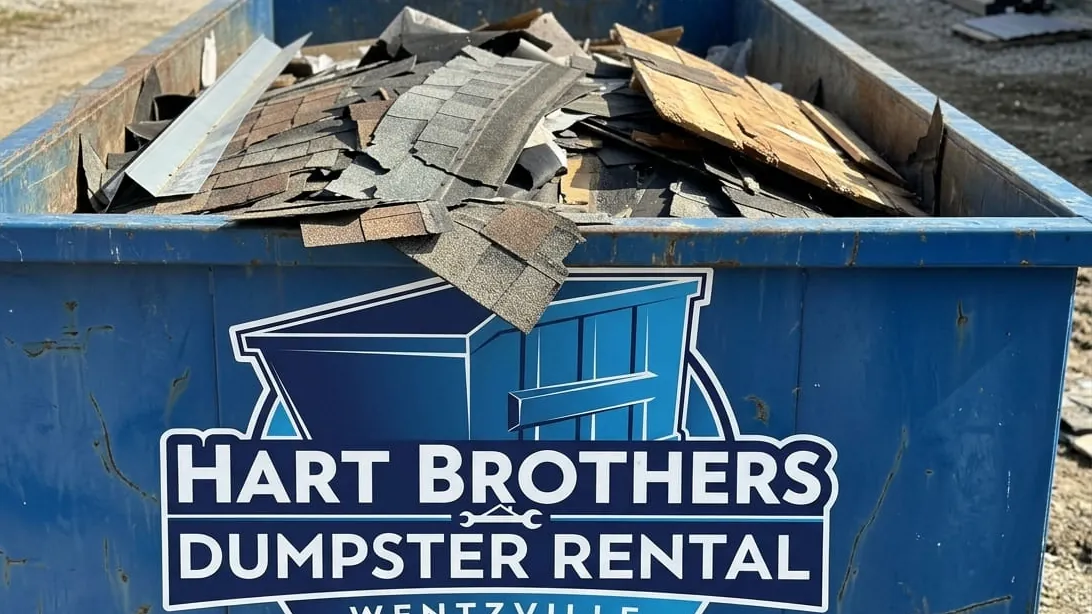
A roof tear-off is the one job where the container that looks big enough is usually wrong, and the one that looks too small is usually right. Shingles are dense: a pile filling a third of a 20 yard box can outweigh that same box packed wall to wall with framing scrap and drywall. In ten-plus years running roll-offs around St. Charles County, the commonest mistake is not ordering too small — it is ordering too big, filling it, and finding the truck cannot legally pull it off the driveway.
Here is how we size a roofing dumpster in Wentzville: by squares and layers, not by how big the roof looks from the street.
Roofing is weight-driven, not volume-driven
Every other job is a volume problem: you fill space with couches, cabinets or deck boards and run out of room before you run out of weight. A roof is the opposite. Tear-off is compact, settles as you throw it, and hits legal axle weight long before the walls are full.
That reverses most generic sizing-chart advice. The question is not "will it all fit" but "how many tons am I putting on the ground, and can it leave." A container that cannot be lifted is not a container.
A square is 100 square feet
Roofers measure in squares. One square is 100 square feet of roof surface — not floor area, not footprint. A 2,000 square foot two-story off Highway Z might carry only 18 or 20 squares, because two floors sit under one roof, while an 1,800 square foot ranch toward Foristell with a wide attached garage can easily be 28. Pitch matters, and cut-up roofs with hips, valleys and dormers waste more per square than a simple gable. Get the number from your roofer — it is the first line on the estimate.
Rough weight per square
Working ranges, including felt, nails and the odd rotten decking board that always comes off with it:
- Standard three-tab asphalt: roughly 200 to 250 pounds per square. This is what went on most of the 1980s and early-1990s stock here.
- Architectural or dimensional shingle: roughly 350 to 450 pounds per square, with premium lines heavier. It has dominated St. Charles County for two decades.
- Cedar shake: lighter per square when dry, but it soaks up water and comes off in bulky pieces.
Twenty-five squares of architectural shingle at 400 pounds is about five tons off one ordinary subdivision house — and that is one layer.
What a second or third layer does
A second layer of asphalt over an existing roof was common here through the 1990s and 2000s because it was cheaper. It costs more now, because when the roof finally comes off, it all comes off.
A second layer does not add a little. It roughly doubles the tonnage; three layers roughly triples it. A 25 square roof that was five tons at one layer becomes ten at two, and at that point you are not choosing between a 20 and a 30 — you are planning a swap.
Older houses around historic downtown Wentzville and Pearce Boulevard, and the pre-war stock toward Historic Main Street in St. Charles, throw extra curveballs: wood shake underneath the asphalt, or heavy organic felt over board decking. Shake under asphalt is common enough that we ask about it on every tear-off on a house built before 1970, and a roofer can usually tell from the eave detail before a shingle moves.
The Wentzville pattern: whole subdivisions age together
Wentzville built in waves. A subdivision off Highway N or David Hoekel Parkway went in over three or four years — same builder, same crews, same shingle from the same supply house. Twenty-something years later every one of those roofs reaches end of life inside the same narrow window.
That is the first refresh wave: decks, kitchens, baths and roofs coming due at once across a whole street. Put a hail cell over it and forty houses on one loop need a roofer, an adjuster and a container the same fortnight. So your neighbours are a decent data source for square count, and being early beats being clever.
Hail sets the calendar
Eastern Missouri sits in a genuinely active severe-weather corridor. Spring through early summer brings the large hail, and one core along the I-70 corridor can put several neighbourhoods into re-roof at once. When that happens, roofers, adjusters and containers all book out in days, not weeks.
The homeowners who finish first called early, not best. Get on a schedule before the estimate is final — a delivery date is easy to move and impossible to conjure. Our same-day and next-day delivery holds up most of the year, but the week after a big hail event is the exception for every operator in the county. Watching the National Weather Service outlooks in April and May is scheduling, not paranoia, and our guide to storm and hail damage cleanup covers the rest of the debris.
Sequence the insurance claim before the debris leaves
Once shingles are in a container and the container is gone, your evidence went with it. Order of operations:
- Photograph before anyone touches it. Wide shots of each slope, close-ups with something for scale beside hail bruises, and collateral hits — gutters, downspouts, soffit, AC condenser fins, window screens. Those often corroborate a roof claim.
- Open the claim first, before tear-off is scheduled. Adjusters want to see the roof, not a photograph of one.
- Keep a damaged shingle sample bagged in the garage. It settles arguments about shingle type, age and impact.
- Then book the crew and the container.
Plain caveat: Missouri insurance rules and claim deadlines change and carriers handle supplements differently, so confirm your timelines with your carrier and the state department of insurance. We are a container company, not adjusters — but the photographs are the cheap part.
Sizing table: squares, layers and the right container
| Roof size | Layers | Recommended container | Notes |
|---|---|---|---|
| Up to 12 squares | 1 | 10 yard | Garage, addition, shed or small ranch; low walls, easy to load. |
| 12–18 squares | 1 | 15 yard | Typical 1990s two-story with attached garage. |
| 18–28 squares | 1 | 20 yard | The workhorse for single-layer architectural tear-off. |
| 28–40 squares | 1 | 30 yard | Large or cut-up roof, many hips and dormers. |
| Up to 12 squares | 2 | 15 yard | A second layer roughly doubles tonnage; volume barely grows. |
| 12–18 squares | 2 | 20 yard | Fill to two-thirds of wall height, not the rim. |
| 18–28 squares | 2 | 30 yard, or 20 yard with a swap | Two staged pulls beat one borderline heavy box. |
| Any size | 3 or more | 20 or 30 yard plus a booked swap | Assume shake or old felt underneath; plan two pulls. |
| Metal, any size | 1 | 10 or 15 yard | Light per square and bulky; worth separating for scrap. |
Two rules run through it. A smaller box hauled twice beats one you cannot legally move. And on any borderline call, take the smaller container and book a next-day swap-out rather than gambling on the heavy end.
Why nobody should order a 40 for a tear-off
We rent 40 yard containers and they are excellent — for bulky light material. On a roof they are a trap. You hit weight at maybe a quarter full, the walls are tall enough to make throwing shingles genuinely hard from a ladder or chute, and the footprint is longer than many Wentzville driveways hold. For tear-off the useful range is the 10 yard through the 30 yard, and most of the county lands on a 20 yard.
Metal roofs west and south of town
Out toward New Melle, Defiance and Foristell, and on acreage along Highway 94, much of what comes off is not asphalt. Pole barns, machine sheds, detached shops and old farmhouse porches wear ribbed steel — far lighter per square than shingle, and clean scrap.
Do not bury it in a mixed load. Stack panels separately, keep fasteners out, and either run it to a metals buyer or tell us up front. Same for old gutters, flashing and copper. Long gravel drives need a word about turning room before delivery day.
Pre-1980 felt: stop and test
Asphalt roofing felt, mastic and some flashing cements made before roughly 1980 can contain asbestos. On the oldest Wentzville houses and the 19th-century stock in St. Charles that is a live possibility, not a theory.
If your house predates 1980 and the roofer finds black felt or tar patching underneath, stop and have it sampled by a licensed inspector rather than tearing it off and sorting it out later. We cannot accept asbestos-containing material in any container. Missouri DNR runs the state asbestos programme, and work of certain scopes triggers a NESHAP inspection and notification first. Thresholds change, so confirm with Missouri DNR or the EPA, not a blog. Our page on what can go in a dumpster in St. Charles County covers the rest of the prohibited list.
Placement, protection and overhead
Where the box sits decides how fast the job goes. The crew throws material down a slope or chute, so the container wants to be tight to the tear-off side, not parked politely at the kerb.
- Protection boards under the rails, always. We bring them standard — more in our notes on protecting a driveway during delivery.
- Stay clear of the drip line, so the box is not under where debris and water sheet off the eave.
- Overhead is what people forget. The hoist arm needs 20 feet or more of clear air. Low silver maple and Bradford pear limbs, service drops and carport overhangs stop a delivery cold.
- Watch the apron. Expansive clay and hard freeze-thaw crack driveway aprons here every winter. If yours is already spidered or heaved at the street edge, say so and we will place to spread the load or set the box on the street. Street placement may need a permit — see our guide to dumpster permits in Wentzville and confirm current rules with the City of Wentzville, since requirements get updated.
HOA rules in the covenanted subdivisions
Plenty of the newer neighbourhoods west and south of town have covenants capping container days, requiring driveway-only placement, or asking for notice to the board. Nobody reads them until a letter arrives. Check yours before booking: a hard day limit pushes you toward a larger box or a same-week swap.
Swaps, magnets and winter
On anything multi-layer or over about 28 squares, book the swap when you book the delivery. A crew stripping a roof should not be standing down at two in the afternoon waiting on an empty.
When the last load is gone, run a magnet sweep. Roofing nails end up in the grass, the mulch beds, the gravel at the end of a rural drive and in tyres. Two passes at right angles across the drip line and driveway, then a third wherever the crew staged. Twenty minutes, and it saves a flat.
Winter has its own rules. Ice on a sloped driveway stops a delivery outright — a loaded roll-off backing down a glazed slope is not worth the risk, so salt and clear the approach that morning. And in a Missouri spring pattern, never let a crew open a roof and leave it overnight with storms forecast. Water in the decking turns a roofing job into a drywall job.
Talk it through before you order
Tell us the square count, the number of layers, the shingle type and the year the house was built, and we will tell you what belongs on the driveway. Two-minute call, and it is the difference between one clean haul and an awkward afternoon. Cole and Wes have been sizing roofing boxes across Wentzville, O'Fallon, Lake Saint Louis and the rural west end since 2015 — flat-rate, licensed and insured. Call Hart Brothers Dumpster Rental at (636) 538-6201, or send the details through our contact page.
Questions this guide did not answer? Call (636) 538-6201. We would rather spend two minutes on the phone than have you order the wrong container.