Cleanouts
Estate Cleanout Checklist for a St. Charles County Home
Clearing a parent's house in St. Charles County means an extra floor of contents nobody counts. Here is the order to work in, what to find before you haul, and how to size the container.
Somebody has to do this, and it usually falls to whoever lives closest. The order of operations matters more than the labour. Families who get it wrong lose the savings bonds, the coin collection and the discharge papers, because those went out in the first load before anyone thought to look.
We have set containers at St. Charles County estate cleanouts since 2015, and the houses have a lot in common: a full basement, a garage, an attic, and forty years nobody sorted in advance.
Do it in this order, and do not start with the container
- Secure the house — locks, mail, utilities.
- Search it thoroughly before anything moves.
- Confirm probate status with the estate's attorney.
- Appraise anything that might carry value.
- Distribute to family, in writing.
- Sell what has a market.
- Donate what is usable but unsaleable.
- Dispose of what is left. Last, never first.
Resist booking a container on day one, however overwhelming the volume. Once a load is on the truck it is gone. Our estate cleanout service is built around arriving when a family is ready to dispose, not while they are still deciding.
Probate and executor pacing
As executor or personal representative you have a duty to the estate separate from your role in the family. Property of real value should not leave the house until the estate's status is clear, and there may be inventory or notice steps first. Missouri probate rules are specific, they differ between a full administration and a small-estate process, and they change — confirm with the estate's attorney before disposing of or giving away anything of value.
None of that stops you working. Secure, search, sort and haul genuine rubbish while the legal side moves. What you should not do is let a relative load a pickup with the tools on a Saturday because they were sitting there.
Secure the house, then search every inch of it
Account for every key. Forward the mail. Keep the heat on — a house with no heat through a Missouri January is a house with burst pipes and a flooded basement. Tell the insurer it is unoccupied; most policies treat a vacant house differently.
Then search. Not skim. This generation did not keep everything in a bank. We have watched families find cash in a chest freezer wrapped in foil and labelled venison, rolled bills in coffee cans on a canning shelf, jewellery in a tackle box, and bearer paper in a workbench drawer under the drill bits. Check:
- Freezers and refrigerators, basement and garage included
- Coffee cans, mason jars, cigar boxes, tins
- Tackle boxes, tool chests, ammo cans, bench drawers
- Coat pockets, shoe boxes, handbags, hems
- Books page by page — Bibles and photo albums especially
- Attic insulation near the hatch; open basement joist bays
Prioritise four things: cash and negotiable paper, jewellery and precious metal, firearms and ammunition, and prescription medication. Firearms need securing immediately by someone competent, and family transfers have rules worth checking. Medication does not go in a container or a toilet — use a pharmacy or law-enforcement take-back.
Paperwork that must never reach the container
Put one banker's box in the kitchen labelled DOCUMENTS. Everything below goes in it as it surfaces. Sort later.
- Deeds, titles, surveys, mortgage payoffs
- Life insurance and beneficiary forms
- Pension and brokerage statements, stock certificates
- Union paperwork and GM retirement records — in this town that is a live benefit file, not a souvenir; survivor benefits have been claimed off a folder somebody nearly binned
- Military discharge records, including the DD–214, and VA correspondence
- Savings bonds, certificates of deposit, old passbooks
- Tax returns, birth and marriage certificates
Anything with an account number gets shredded, not binned. A roll-off on a driveway for a week is not secure document destruction.
The basement is the whole story here
Nearly every house here has a full basement. You are not clearing a three-bedroom house — you are clearing one plus an entire extra floor, plus a garage and an attic. Families underestimate this every time.
What is down there is consistent: decades of storage, a workbench and a lifetime of tools, canning shelves, holiday tubs enough to fill a pickup bed twice, an old chest freezer, exercise equipment nobody used, and sealed boxes from three previous moves. Our guide to basement cleanout and finishing debris covers the volume side.
If that basement has ever taken water
Expansive clay soil here moves with moisture and pushes water through foundation walls; a failed sump pump or backed-up floor drain does the rest. If the basement has flooded at any point, assume cardboard, paper, photographs, upholstery, mattresses and particleboard are already gone. Musty smell, tide lines and swollen chipboard tell you before you open anything. Decide fast and do not build a maybe pile — those get moved four times and thrown out anyway. Pull photographs and documents out to dry flat. Wet material is far heavier than dry.
Appraise before you haul
Get a walkthrough from a local estate buyer, auctioneer or appraiser before the first load leaves. The categories thrown out by mistake:
- Tools and shop equipment. This is a trades town — saws, welders, hand tools and roll-away chests have a real market.
- Firearms, ammunition and reloading gear, appraised rather than sold at the door.
- Coins, currency and sterling, including the jar of change.
- Quilts and textiles — do not launder before appraisal.
- Fishing and hunting gear, decoys, bamboo rods and older reels.
- Solid wood furniture, especially with a maker's mark.
- Railroad and Wabash-era memorabilia. Wentzville grew up around that line, and lanterns, timetables and depot pieces have collectors.
Older houses have value in the house itself
In historic downtown Wentzville near Pearce Boulevard, or on Historic Main Street in St. Charles, the fixtures are part of the estate. Old-growth trim, original hardware, mantels, claw-foot tubs and period fixtures are worth pulling for salvage rather than breaking out. Plaster and lath, by contrast, is pure disposal at two to three times the weight of drywall.
Estate sale, auction or donation
An on-site estate sale suits a full house with broad contents and works best while it is still furnished. An auction suits concentrated value — tools, guns, coins, shop and farm equipment — and good houses work across St. Charles and the neighbouring counties. Donation takes the rest: Habitat ReStore for cabinets, doors and furniture, thrift shops for clothing and housewares. Confirm what each accepts first, because donation rules tighten without notice.
The sorting method that holds up
One room at a time, finished before you open another. Four categories, no fifth: keep, sell, donate, dispose. Stage the piles in the garage, not the driveway — a Missouri spring will put hail or three inches of rain on them between Saturday and Sunday. One decision-maker per room. Four siblings deciding a drawer together is how a cleanout takes six months.
| Room or area | What is usually in it | Where it goes | Watch out for |
|---|---|---|---|
| Bedrooms and closets | Clothing, linens, jewellery, shoe boxes, paperwork | Donate clothing; appraise jewellery; documents to the box | Cash in pockets and hems; items claimed twice |
| Kitchen | Cookware, small appliances, canned goods, tins | Donate usable goods; dispose of the rest | Cash in coffee cans and jars; the deep freeze |
| Living and dining | Furniture, china, glassware, books, photographs | Sell or appraise; family distribution | Documents inside books; china worth less than people think |
| Basement — storage | Boxes from prior moves, holiday tubs, canning shelves | Mostly dispose; open every box first | Water damage; mould; hidden cash and paper |
| Basement — workshop | Bench, hand and power tools, hardware, offcuts | Appraise and sell — highest-value area in the house | Solvents and fuel under the bench; loose ammunition |
| Basement — mechanical | Furnace, water heater, ductwork, old freezer | Scrap metal; refrigerant units handled separately | Pre-1980 pipe and duct wrap — stop and test |
| Garage | Lawn equipment, paint, chemicals, tyres, ladders | Household hazardous waste drop-off; scrap; dispose | Fuel cans, propane, pool chemicals, pesticides |
| Attic | Decorations, suitcases, insulation, furniture | Mostly dispose; check every container | Heat-damaged photographs; footing on open joists |
| Outbuildings and pole barns | Implements, fencing, fuel, salvage metal | Auction, scrap, dispose | Fuel tanks, chemicals, septic and well components |
The carry is the biggest time sink
Everything in that basement comes up a stairwell one armload at a time, around a turn and out to the driveway. That carry — not the sorting, not the loading — is what makes these jobs run long. Plan two on the stairs, a third staging at the top, and a stair-climbing hand truck. A walkout changes everything: with a door at grade we set the container where you can wheel straight out, and the job moves twice as fast. Tell us which you have when you call. Boards go down as standard — see our notes on driveway protection during delivery.
Sizing and sequencing
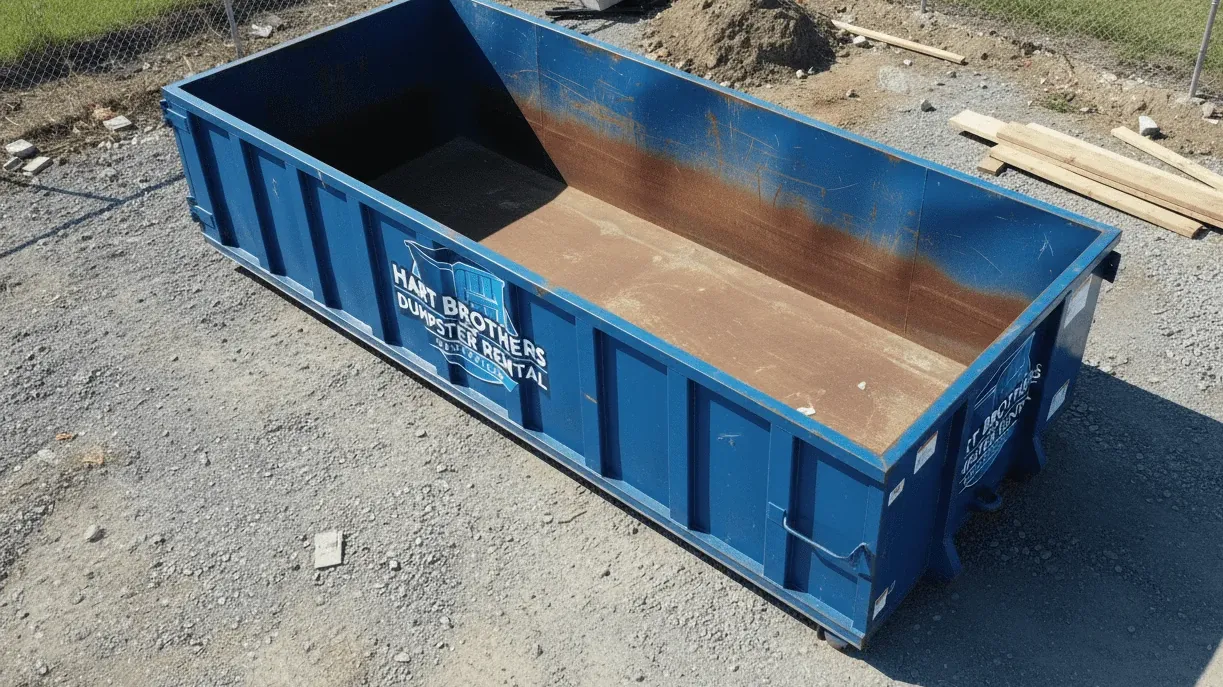
For a full-basement house we usually recommend a 20 yard container for the first pass with a next-day swap rather than one 30 yard sitting there three weeks. A 20 has lower walls and loads far easier by hand when you are carrying up from a basement, and sequencing matches how families work: the first box takes obvious rubbish, the second takes what the sale and donation runs left behind. If the family has already thinned things out, a 10 yard may do — our guide to choosing a dumpster size compares them. Between sizes, go up.
Pre-1980 houses: stop and test
If the house predates 1980, assume asbestos in floor tile and mastic, plaster skim coats, siding, roofing felt and — the one that catches people here — pipe and duct wrap around old basement ductwork and boilers. That crumbly grey wrap on a gravity furnace is exactly what it looks like. Do not pull it or sweep it. Stop and test. The Missouri Department of Natural Resources runs the state asbestos programme and requirements change, so confirm current rules first. We cannot accept asbestos-containing material in any container. Pre-1978 houses also carry lead paint, bringing EPA renovation rules into play if contractors disturb painted surfaces.
What cannot go in the container
A garage and basement cleanout produces more prohibited material than any other job. None of this goes in a roll-off:
- Paint, stain, solvents, thinners
- Motor oil, antifreeze, gasoline and fuel cans
- Lawn chemicals, pool chemicals, old pesticides
- Propane cylinders and pressurised tanks
- Batteries, tyres, electronics
- Refrigerators, freezers and air conditioners with refrigerant
These go to a St. Charles County household hazardous waste drop-off. There is no retail paint take-back programme in Missouri, so do not plan on returning leftover paint to a hardware store — check current drop-off days and accepted items with St. Charles County first, since those lists change. Our page on what can and cannot go in a dumpster has the full list, and local recycling and disposal options covers the rest.
Separate the scrap metal
An old furnace, water heater, radiators, ductwork, steel shelving and bed frames add up. Yards operate throughout the county and along the I–70 corridor. Pull that into its own pile before the container arrives — it keeps weight out of the load and it is one of the few parts of a cleanout that pays you back.
Set a pace you can hold
Do this over weekends, not one exhausting push. In a GM shift-work town, weekends and shutdown weeks are when families can get there together, and that suits the work: four or five focused Saturdays beats one brutal week where everyone is too tired by Wednesday to decide well. If you would rather skip the carry, our junk removal crew can do the labour, and the same method applies to a straightforward home cleanout.
When you are ready for a container — and not before — call Hart Brothers Dumpster Rental at (636) 538-6201. Tell us whether the basement is a walkout, what era the house is, and which weekend you are working. We will put the right size in the right spot with boards down. You can also reach Cole or Wes through our contact page.
Questions this guide did not answer? Call (636) 538-6201. We would rather spend two minutes on the phone than have you order the wrong container.