Recycling
Recycling and Disposal in St. Charles County: Where It All Actually Goes
Curbside, county drop-off, hazardous waste event or roll-off container: which stream your material belongs in, why clean loads recover value and mixed loads do not, and where it ends up.
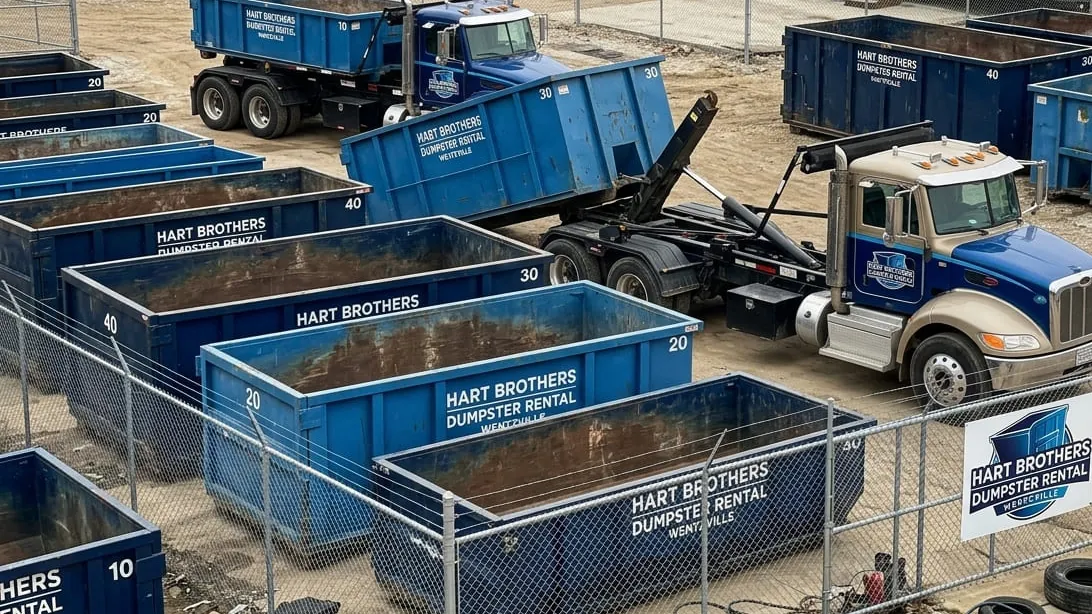
Every load that leaves a driveway in Wentzville goes somewhere specific, and it is not one destination. Depending on what is in it, the same twenty yards can end up at a sanitary landfill, a C&D landfill, a composting yard, a scrap yard or a county hazardous waste collection — often three of those at once, out of three separate loads.
Whether your material gets recovered or buried is mostly decided in your driveway, before we ever hook onto the container. Here is how the streams actually work in St. Charles County.
One caveat: drop-off sites, dates, hours and accepted-item lists change year to year. What follows is the shape of the system, not a schedule. Confirm current details with St. Charles County or the City of Wentzville before you build a weekend around a trip.
Four different tools, four different jobs
Curbside collection handles the weekly stream — household trash, single-stream recycling, and in season the yard waste your hauler takes separately. It is metered by the cart, and the fastest way to get a tag on yours instead of an empty cart is to put a bathroom vanity in it.
A county or municipal drop-off takes specific streams — electronics, tyres, appliances, sometimes cardboard or scrap. You haul and unload it yourself. Perfect for a boot full of old monitors, useless for a kitchen.
A household hazardous waste drop-off handles what neither of those will touch: liquids and chemicals. Separate site, separate rules, often separate dates.
A roll-off container is for volume and weight — more than a car can carry, over days rather than one trip. A bathroom, a garage teardown, a full estate cleanout. It goes to whichever facility matches what is in it.
Most real projects use two or three: a container for the bulk, a hazardous waste trip for the paint shelf, a drop-off run for the old television. Plan all three at the start.
Missouri bans yard waste from landfills
This is state law, not a company preference. Grass, leaves, brush and branches cannot be buried in a Missouri sanitary landfill. Missouri DNR administers the rules, and that ban is why an organics infrastructure exists here at all.
Practically: yard waste rides as its own clean load to a composting or organics facility, where it is ground for mulch. It never goes into a construction load, and a scale house that finds brush through a C&D load makes it your problem. When we run yard waste removal alongside a remodel, that is deliberately two containers.
Local tree debris here is oak, hickory, maple, sycamore, silver maple and Bradford pear, and hardwood limb wood is far heavier than people expect — green oak and hickory are dense, wet and unforgiving on a scale, and a pile that looks like ten yards can outweigh a container of drywall. Silver maple and Bradford pear fill a box with volume rather than weight. That mix is what makes storm and hail cleanup hard to size by eye.
Burning is not a substitute. Outdoor burning is restricted or banned in many St. Charles County municipalities, and rules differ between city limits and unincorporated county — check with your own city, because these ordinances get revised. Pressure-treated lumber must never be burned. The preservatives go into the smoke and stay in the ash.
Clean single-material loads recover value. Mixed loads do not.
That is the whole principle. A recycler wants a load of one thing. Contaminate it with a second thing and it becomes waste, and gets buried.
- Clean concrete, block and brick — crushed for fill and road base. Egress window spoil and driveway breakout are ideal if kept separate; see how we run concrete and heavy debris loads.
- Clean untreated wood — ground for mulch or biomass fuel.
- Metal — scrapped and remelted. Almost nothing disqualifies it except being buried in a mixed load where nobody finds it.
- Cardboard — baled and sold as fibre, provided it is dry and clean.
When a job produces a lot of one material, ask for a dedicated box. On a deck removal or first-refresh remodel, that means one container for treated lumber and a separate pile for hangers, joist ties and railing brackets.
Scrap metal is a bigger stream than people realise
This is a trades town with GM Wentzville Assembly at the centre of it, and metal turns up everywhere. An old octopus furnace or a rusted water heater. Galvanised ductwork out of a basement ceiling. Steel shelving that has held paint cans since 1994. Exercise equipment — every basement here has a treadmill nobody has touched in fifteen years. Deck railings and hangers off a tear-off. And out around New Melle, Defiance, Foristell and Flint Hill, the farm and outbuilding metal: panel gates, roofing tin off a pole barn, wire, fence posts.
None of that needs burying. Pulled aside it is a scrap load; left in a mixed container it is buried metal. On a junk removal or whole-house clear, stage metal in one corner of the garage as you go.
C&D versus municipal solid waste
Municipal solid waste — household trash, furniture, mattresses, general junk — goes to a lined sanitary landfill. Construction and demolition debris — lumber, drywall, shingles, concrete, siding, cabinetry — goes to a C&D landfill under a different permit, and C&D facilities are often where recovery happens because the stream is cleaner.
That is why we ask what is going in the box. A demolition load and a house clear-out are not the same product to a facility even at identical weight. More detail sits in our guide to construction debris disposal in St. Charles County and the full list of what can and cannot go in a container here.
Household hazardous waste, and the PaintCare question
Paint, stains and solvents. Motor oil and antifreeze. Old mower and generator fuel. Lawn and garden chemicals, herbicides, pool chemicals. Batteries of every type. Fluorescent tubes and CFLs, which contain mercury. Aerosols. None of it goes in a roll-off or in household trash. It goes to a St. Charles County household hazardous waste drop-off.
Worth stating plainly, because guides written for other states get this wrong constantly: PaintCare does not operate in Missouri. There is no retail paint take-back scheme at the hardware store here. If a website tells you to drop leftover latex at a paint retailer, it is describing a programme that does not exist in this state. The county programme is the route. Latex dried solid is handled differently from liquid paint in some places — confirm with the county, not an out-of-state blog, because the rules change. General guidance on household chemicals is at the EPA.
The special cases
Electronics and CRTs. Computers, monitors, printers, stereo gear. Old tube televisions are the difficult ones — leaded glass, no scrap value, and most facilities charge to take them. Every basement clear-out turns one up behind the water heater.
Refrigerant appliances. Fridges, freezers, window air conditioners, dehumidifiers, the basement beer fridge. Refrigerant must be professionally evacuated and documented before the unit is scrapped. Once tagged, the shell is scrap steel.
Tyres. Banned from ordinary disposal and handled through separate programmes. They turn up in every pole barn out west, sometimes twenty at a time.
Mattresses. Often handled separately at the facility, because they compact badly and foul equipment. Count them and declare them rather than sliding them in.
The basement factor
Nearly every house here has a full basement, and that one fact makes disposal in this county different from anywhere in the south. A whole extra floor of storage means an unusual volume of paper, cardboard and old electronics hitting the system at once when a house gets cleared.
Most of it is recyclable — if it stayed dry. Decades of file boxes, schoolwork, tax records and moving boxes from three houses ago are clean fibre worth baling. Wet, from a failed sump pump or clay soil pushing moisture through the wall, it is mouldy, several times heavier and worthless. That is why sequence matters on a basement cleanout or finishing job: get the dry paper and cardboard out and separated first, before the next storm finds it. Our home cleanout checklist works through the order.
Salvage and reuse before disposal
The cheapest disposal is material that never becomes waste. Historic downtown Wentzville around Pearce Boulevard, and Main Street in St. Charles, hold 19th-century brick and frame with old-growth framing, period doors, hardware and mantels. Architectural salvage buyers want that material and will sometimes pull it themselves.
For ordinary houses, building-material reuse outlets take usable cabinets, doors, windows, fixtures, appliances and lumber. A 1998 kitchen out of an O'Fallon subdivision is dated, not broken. Pull the cabinets carefully and they become somebody's garage instead of eight yards of your container.
After severe weather
After tornadoes, big hail or an ice storm, municipalities here sometimes run special storm debris collection, usually sorted into separate streams at the kerb: vegetative debris in one pile, construction debris in another, appliances and metal in a third, hazardous items apart. Mixed piles get skipped, because crews haul to different destinations. These programmes are announced case by case, so watch your city's channels and do not assume the last event's rules apply.
Material, destination, disqualifier
| Material | Best destination | What disqualifies it |
|---|---|---|
| Grass, leaves, brush, limbs | Composting or organics facility | Mixing with trash, lumber or dirty root balls |
| Clean concrete, block, brick | Crushed for fill and road base | Soil, wood, trash, heavy rebar, coatings |
| Untreated dimensional lumber | Ground for mulch or biomass fuel | Paint, treatment, laminate, bulk fasteners |
| Pressure-treated lumber and decking | C&D landfill, in a container | Burning — never; not clean wood |
| Scrap metal, ductwork, appliances | Scrap yard for remelt | Burial in a mixed load; refrigerant not yet evacuated |
| Cardboard and dry paper | Baled and sold as fibre | Water damage, mould, grease, bulk foam |
| Paint, solvents, fuels, garden chemicals | County household hazardous waste drop-off | Unlabelled or leaking containers; no PaintCare in Missouri |
| Electronics, CRT televisions and monitors | Electronics recycling drop-off | Nothing — expect a charge on tube glass |
| Fridges, freezers, window AC units | Scrap after certified refrigerant evacuation | No evacuation paperwork |
| Tyres | Dedicated tyre programme | Rims left on at some sites; disposal banned |
| Mattresses and box springs | Separate handling at the facility | Wet or infested; not declared in advance |
| Working cabinets, doors, fixtures | Building material reuse outlet | Damage, missing parts, swollen particleboard |
| Household junk and furniture | Sanitary landfill | Liquids, chemicals, anything hazardous |
| Asbestos-containing material | Licensed abatement contractor only | Everything — we cannot take it in any container |
Why it matters here specifically
Eastern Missouri clay soil does not absorb water, it sheds it, and runoff takes whatever is on the ground with it. Peruque Creek runs through Wentzville and the county sits in the Missouri River watershed, so what washes off a driveway pile is in a creek quickly.
Anyone here in 1993 does not need this explained; that flood is still the benchmark for what these rivers do. The practical effect of stormwater rules on a job site is simple: nothing gets stockpiled where runoff reaches a creek, ditch or storm inlet. Debris goes in a container with the doors closed, or on a tarp away from the drainage path.
How we handle it
When you call, we ask what is going in the box — not to be difficult, but because the answer decides which facility it goes to and whether anything in it can be recovered. Heavy concrete gets its own container; brush gets its own load.
We run 10, 15, 20, 30 and 40 yard containers with next-day swap-outs, so two streams on one job is not the problem people assume. Cole and Wes Hart have hauled out of Wentzville since 2015, from the I-70 corridor to the acreage out on Highway D and DD. For a straight answer about which stream your material belongs in, call Hart Brothers Dumpster Rental Wentzville at (636) 538-6201 or use our contact page. Tell us what the job is and we will tell you how many boxes it really needs.
Questions this guide did not answer? Call (636) 538-6201. We would rather spend two minutes on the phone than have you order the wrong container.